|
>>Jump to About Durban>>
Welcome to South Africa! We welcome you with open arms and hearts and the warmest, widest of smiles, excited to invite you to our shores, homes and braais!
Come and experience our hospitality wherever you go and get in touch with our wide variety of fascinating cultures and local traditions. Our people are ready to show you our country's natural wonders, draw you into the rhythm and soul of Africa, give you close encounters with our regal wildlife and take you on an unforgettable journey through our ancient and recent past. We guarantee you will have incredible stories to tell.
With its first-world infrastructure, balmy climate, breathtaking scenery and world-class hotels, South Africa is an ideal location for international congresses and conventions.
TIME DIFFERENCE
South Africa operates two hours ahead of Greenwich Mean Time throughout the year, making it an hour ahead of Central European Winter Time and seven hours in advance of Eastern Standard Winter Time. Calculate the time difference between South Africa and your city here.
CURRENCY AND BANKS
The unit of currency in South Africa is the South African Rand (ZAR) and is indicated with a capital R so that, for example, three Rand and fifty cents would be written R3.50. South Africa has a decimal currency system with one Rand equaling 100 cents. Denomination of Rand notes are R200, R100, R50, R20, and R10 and of the coins are R5, R2, R1, 50c, 20c and 10c.
Facilities for cashing traveller’s cheques are available at banks (operating hours are Monday - Friday 09:00 - 15:30, Saturdays 08:30 - 11:00) and at most hotels. Banks are closed on Sundays. Foreign exchange agencies are open during the week and on Saturdays. Automatic teller machines (ATM) are open 24 hours and are located at most banks as well as at the conference Venue. International credit cards (Visa, Diners Club, MasterCard and American Express) are accepted at the majority of hotels, restaurants and shops.
See the latest international exchange rates here.
TIPPING
Gratuities are expected in South Africa. A guideline for visitors is the following: Airport porters ZAR5.00 per item, taxis 10%, waiters and waitresses in restaurants 10%.
ELECTRICITY SUPPLY
The electricity supply in South Africa is 220 - 240 volts, 50 Hz. The connection for appliances is a round three-pin plug. Most hotels provide dual-voltage two-pin razor sockets (100-120 volts and 220-240 volts).
HEALTH
There are no compulsory vaccination requirements for persons entering South Africa however certain areas of the country, including the North-Eastern half of KwaZulu-Natal are Malaria regions. We do have to advise that if you anticipate travelling to a malaria area it is recommended that you take prophylactics before arrival and the necessary precautions while in the area (e.g. protective clothing, insect repellents).
South African doctors and dentists are highly trained professionals and hospitals are well equipped. It is strongly advised that delegates take appropriate health insurance prior to their departure. Yellow fever infected countries require inoculations to enter South Africa, i.e. Brazil, certain South American neighbouring countries and central Africa.
It is safe to drink tap water throughout South Africa. However, for those who prefer bottled mineral water, this is readily available in various stores. Smoking is prohibited by law in most public buildings in South Africa (airports, hotels, restaurants etc) except in designated smoking areas.
SECURITY
For those participants who have not previously visited South Africa, or Durban, and are concerned about personal safety, we wish to assure all visitors that Durban is like any other major city with good and bad areas. Common sense will ensure a trouble free and enjoyable conference and vacation. The area around the Southern Sun Elangeni Hotel is safe and well monitored at all times but we advise that you do not walk alone after dark in unpopulated streets. Ostentatious displays of wealth should be avoided at all times.
Useful Websites
<<Go back to top<<
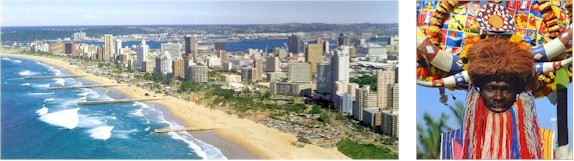
The city of Durban, in the province of KwaZulu-Natal, situated on the subtropical East Coast is South Africa's third largest city and is a prime tourist destination in Southern Africa. The city surrounds Durban Bay, the busiest port in Africa and the world's ninth largest. Superb air and land transport infrastructure exists, with many of the major international airlines flying directly to South Africa. Durban is nestled on the coast of the warm Indian Ocean with golden beaches, parks, museums, theatres and world class shopping malls.
Durban's subtropical weather is sultry in summer and mild in winter. Durban is noted for it's rich cultural diversity, and delegates will be greeted by a kaleidoscope of amongst others, Indian, Colonial and African traditions that have prospered in the city and given rise to a wide variety of cuisine, restaurants, arts and crafts, and ethnic dance forms. Within a two-hour drive from Durban, delegates can be on safari at a game reserve, visiting traditional Zulu villages, hiking or trout fishing in the majestic Drakensberg Mountains. KwaZulu - Natal boasts two world heritage sites - one in the Drakensberg mountains, which contains one of the highest waterfalls in the world, and the other, the St Lucia Wetlands Park, which is adjacent to Sodwana Bay, the site of the recent coelacanth colony discovery. Durban is an ideal base from which to explore Southern Africa.
SHOPPING IN DURBAN
Most shops in the city centre and suburbs open between 08.00 and 17.00 to 17.30 hours. Shops in major shopping malls open at 09.00 and close at 19.00 hours or later. Government agencies still keep to traditional weekday only hours. Muslim-owned businesses close at noon on Fridays and re-open at 13.00 hours.
WEATHER
Durban is famous for its mild sub-tropical climate with warm wet summers and mild moist to dry winters. Due to large altitude variations, some western suburbs get very cold in the winter. Durban has an annual rainfall of 1,009 millimetres (39.7 in), with daytime maxima peaking from January to March at 28 °C (82 °F) and the minimum is 21 °C (70 °F), dropping to daytime highs from June to August of 23 °C (73 °F) and the minimum is 11 °C (52 °F).
The weather in July is normally mild and pleasant, with daily temperatures ranging between 20ºC during the day and 10ºC - 15ºC (68F and 50-60F) overnight. It is recommended that you wear some warm clothes for the evenings and bring a jacket or raincoat.
TOURIST ATTRACTIONS
|